

In Profile - Henrike Lähnemann
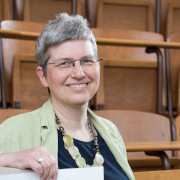
I first came to Britain was when I went on a year abroad in Edinburgh in 1989, studying art history, literature and theology. It was a hugely exciting and formative year which really made me fall in love with Edinburgh, the UK and British academic culture. The lecturers at the university and staff in the National Library of Scotland taught me hands-on approaches to history and debating in English – not just academic issues but even more political events in a year that saw the fall of the Berlin wall, mad cow disease and the poll tax. I went back to Germany to continue my studies but determined to come back. After a year at the FU Berlin watching German reunification unfold, taking my MA in Bamberg, living in the commune-like Theological College in Göttingen during my PhD, it took until half-way through my first job in Tübingen, before I got another opportunity. The move to Oxford for a year in 2001 came in the form of an invitation by Nigel Palmer and a year-long scholarship by the Humboldt Foundation. This experience and working with the congenial group of colleagues which is the Anglo-German Colloquium emboldened me to apply for the Chair of German Studies at Newcastle University where I spent eight and a half very happy years from 2006. In 2015, I became the successor of Nigel Palmer and moved back to Oxford. My personal interest lies in literature, music, manuscripts and art – fortunately all areas which I can claim to be work as well as leisure!
For an audio-visual introduction, watch a recent interview with me about women in academia https://youtu.be/8I9Bg6C9uNo (on my youtube channel) or follow my twitter account @HLaehnemann.
What does a typical day in your job look like? Is there any link/relation to German/ Germany?
I had the weirdest experience just now of reading the write-up of a day in my life in a book published this spring, ‘Die Glücklichen’, about successful women in their fifties. The journalist Susanne Beyer shadowed me for a day in March 2020 and described in detail the classes I was teaching on that day – actually two of my favourites: ‘History of the Book’ (Blog series) with a group of second-year students in the printing press of the Bodleian Library where we typeset a passage from Martin Luther’s ‘Von der Freiheit eines Christenmenschen‘, and translation from pre-modern German with a group of finalists where we discussed how to translate a 17th century description of a witches dance; between these two classes, she interviewed me in my office among the books and came to lunch in College (one of the last pre-lockdown!), relishing the interdisciplinary table talks with my colleagues. I must admit that this was a slightly glorified version of a typical day since I did not show her my dealing with the necessary admin and email backlog but overall I am very lucky in being able to engage every day with research I love, curious students and inspiring colleagues.
Which city in Germany have you been studying/researching and what was/were the reason/s for choosing it?
My research has focused on two very different important hubs of medieval Germany: Nürnberg and Lüneburg – and both accidentally-on purpose places I grew up in. I remember vividly at the age of 5 going on a first visit to the Protestant convent of Lüne where the nuns lived whose letters I am now editing; next year is the 850th anniversary of the foundation of the convent, and we are going to launch the first volume of the edition in April there and then. The brick-Gothic buildings around the medieval brass fountain are the most stunning setting imaginable for a book launch!
Can you cook a German dish without a recipe? If so, which one and where have you learned it?
When I lectured at Tübingen, one of the students working as my research assistant suggested we should make teaching more reciprocal: in exchange for me introducing him to Middle High German grammar, he would give me a tutorial in making Linsen mit Spätzle from scratch. This skill has stood me in good stand and is now my show piece dish whenever I invite students for a dinner party; I take the students through the steps of beating the dough (100gr coarsely ground flour, 1 egg, a pinch of salt, a dash of sparkling water per person) until bubbles are forming on the surface. Working the Spätzle dough through a colander into boiling water is a guaranteed ice-breaker!
What advice would you give to UK/Irish students and researchers who are thinking of pursuing research abroad in Germany? Or alternatively to German students and researchers who are thinking of pursuing research abroad in the UK/Ireland?
I can really recommend to take the initiative and apply for internships. When I was on my year abroad in Edinburgh, I fell in love with the Special Collections at the National Library of Scotland and simply asked whether I could work for them during my Easter holiday. I was given the job to transfer the archive of a Lord Lynedoch from the tin boxes in which they had arrived (stuffed with letters but also with cloth and guano samples!) into acid free folders – and then was allowed to keep the boxes which still serve as archival boxes in my office today! And I have enjoyed this form of work relationship equally as an employer; some of the most innovative projects I have been involved in during my time in the UK came about because of my interns who came thanks to DAAD (thank-you!), Erasmus+ (of tender memory – may it rise again in glory) and Studienstiftung funding: running a Kurt Schwitters inspired competition in Newcastle, promoting Reformation pamphlets in Oxford, taking digital initiatives further. Have a look at some of the reports here: History of the Book and Performing Medieval Studies.